
Phonemic Awareness or Reading Simplified?

Reading an EducationWeek post recently led me to dive deeper into how Reading Simplified is different from, and in my experience much more effective than, phonemic awareness programs such as Heggerty or Kilpatrick. I got lost in the study that supports EducationWeek’s assertion that

“researchers found that phonemic awareness instruction with letters led to bigger returns over a longer period of time…”1

This 2021 study, They Say You Can Do Phonemic Awareness Instruction “In the Dark”, But Should You? A Critical Evaluation of the Trend Toward Advanced Phonemic Awareness Training, provides a discussion of the evidence base of advanced phonemic awareness training for striving readers. The authors make a compelling argument that

“available evidence indicates that student reading and spelling outcomes are stronger when phonemic awareness instruction uses letters and words.” 2

After reading this paper, I found myself notching another win for the Switch It! activity from Reading Simplified that I have used successfully with my students for the past five years. Switch It! has given me a tool to explode reading growth in students with Dyslexia, ADHD, or Autism Spectrum Disorder, and with English Language Learners, and students who were left behind in reading when their schools closed during COVID. From the first session of Switch It! students are using letters to practice phoneme manipulation – addition, deletion, substitution – and blending real words that they can use in their reading practice.

A typical Reading Simplified lesson opens with rereading a text from a prior lesson, then moves right into Switch It! When my students “play” Switch It! they use letter tiles to manipulate sound “switches” in words. To provide additional practice students say each sound while writing the word they have created. Finally, students blend and read the new word aloud. The Switch It! word lists allow me to provide explicit, systematic, sound-based instruction that I can target to my student’s ability level and area of need. Students are then primed to go on to other challenging tasks such as work on advanced phonics, spelling, and decoding and discussing a new text.

Want to know more about Reading Simplified? Here are links to Switch It! and Sort It!, the two Reading Simplified activities that are the backbone of my reading instruction.

  1. Education Week
    https://www.edweek.org/teaching-learning/how-much-time-should-teachers-spend-on-a-foundational-reading-skill-research-offers-clues/2024/02 ↩︎
  2. The Society for the Improvement of Psychological Science
    https://osf.io/preprints/psyarxiv/ajxbv_v1 ↩︎
Hadyn Fleming Shares What It’s Like to Grow Up with Dyslexia

Teachers use the summer months to catch up on reading and podcasts that help us better serve our students.  One of the podcasts I am catching up on this summer is Science of Reading: The Podcast from Amplify Education.  In an episode from December 2021, Susan Lambert talks to 10th grader Hadyn Fleming about his experiences growing up with dyslexia.  Hadyn currently lives and attends high school in Cheyenne, Wyoming.  He is in Honors Biology and Honors English classes, and he loves US History.  He is a self-proclaimed gym rat who plays on the football team, throws shot put, discus, and hammer, and loves to ski.  He has moved around the US and Mexico with his family, and says of them, “We are adventurers!”  Hadyn’s confidence and charisma are absolutely contagious!

But life hasn’t always been easy for Hadyn.  Like many people with dyslexia, Hadyn had a sense early on that something wasn’t right.  The words in simple books that his friends had mastered looked like scribbles.  A teachers comment, “God, you are so stupid,” was absolutely crushing.  Hadyn became depressed; he felt stuck and insecure. Hadyn was lucky that his parents were able to locate help for him.  When he was 10 he attended Rocky Mountain Camp, a 5-week summer program where he learned that he was not alone in his struggle. Hadyn worked with a 1:1 tutor who provided explicit reading and writing instruction.  After working for up to six hours each day, campers were able to participate in outdoor activities such as kayaking and hiking. Hadyn felt for the first time that “I have a lot of potential if I learn to use it correctly.”  Following Rocky Mountain Camp, Hadyn attended Vertical Skills Academy for two years.  There he continued to work hard to read and write and build his confidence. Hadyn was later diagnosed with ADHD and admits that when his medication wears off it is hard to stay on track or find the right words to express himself. Hadyn admits that he feels very lucky to have a supportive family that helped him identify his dyslexia early and had the resources to help him close the gap.  

When asked to describe his dyslexia, Hadyn said that it is like an obstacle course, and that every time a teacher asks a question he has to go through the course again. This is in every subject. Like in an obstacle course, Hadyn gets bumped and bruised through it all.  Hadyn has learned to advocate for what he needs to make it through the course, especially additional time for tasks or tests and the use of audio books. Hadyn says he can now read just fine, but like other dyslexics the cognitive demands of reading interfere with his comprehension. Using audio books allows Hadyn to use his mental energy to understand and remember what he reads and to fully participate in class discussions.

In graduate school I was introduced to the challenges of Twice-Exceptional (2e) Learners. These students have learning disabilities, like Hadyn. They also have exceptional intelligence, like Hadyn. The combination means that 2e students are acutely aware of their disabilities, but that their giftedness masks their struggles. These students are not lazy or dumb. They require teachers who will look beyond behaviors to find the underlying cause of the student’s struggle and provide the appropriate intervention. If you are interested in more information about 2e Learners, I highly recommend the book Teaching Twice Exceptional Learners in Today’s Classroom by Emily Kircher-Morris. I turn to this book each time I encounter a new student to remind me of the importance of meeting these students where they are and providing interventions designed to support their unique needs.

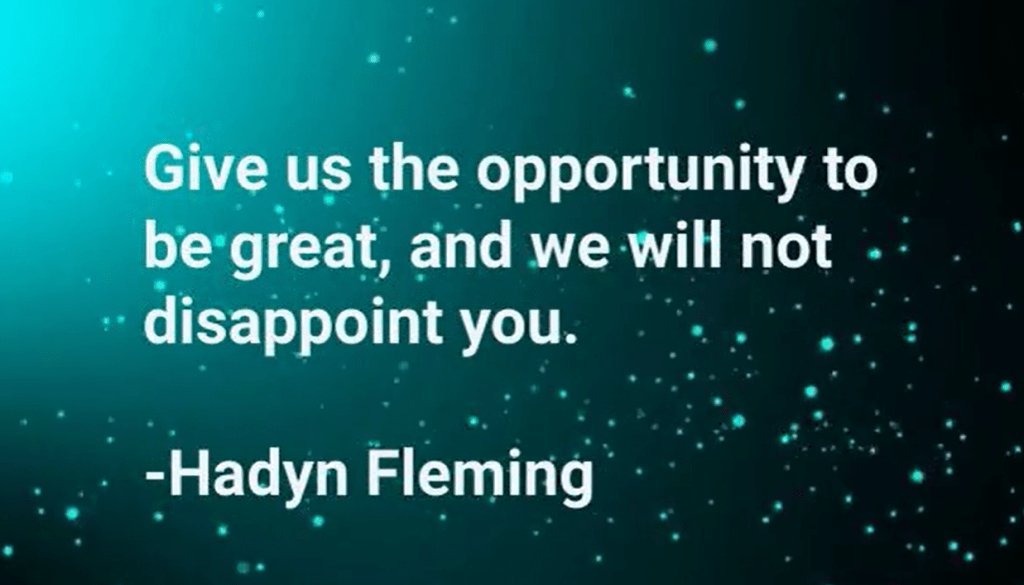
Hadyn’s goal is to be an aeronautical engineer.  He wants to try one or two AP classes next year, and he plans to apply to Harvard University. While most of us really cannot understand how difficult academic work is for Hadyn, we can support Hadyn and other students like him by giving them the opportunity to be great. We will not be disappointed!

If you know of a student who would benefit from working with an experienced educator of Twice Exceptional Learners, please get in touch via my website, Sand Dollar Tutoring, for more information about private tutoring in the areas of reading, writing, and executive function skills.

Science of Reading the Podcast S4-E12: A conversation on growing up with dyslexia with 10th grader Hadyn Fleming

sanddollartutoring.com