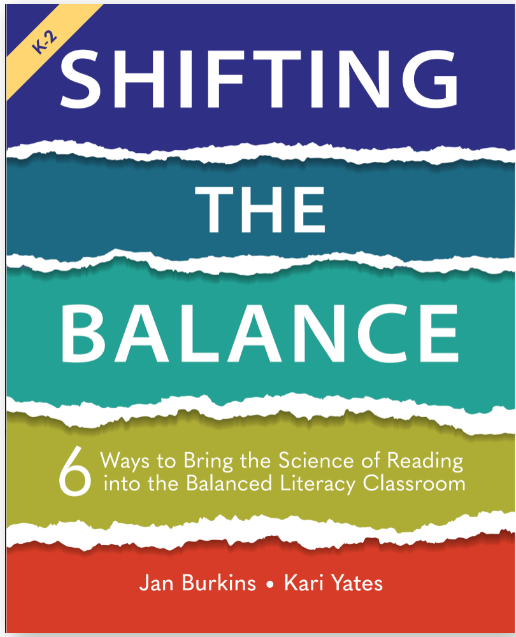
Shifting the Balance: 6 Ways to Bring the Science of Reading into the Balanced Literacy Classroom by Jan Burkins and Kari Yates
If you know me, or if you have read my previous posts, you know that I love everything about teaching kids to read. The biggest challenge I have faced as a teacher and tutor is the frustration kids feel when reading is really, really hard for them. So hard that they begin to dislike books, writing, and pretty much everything to do with literacy. They feel so defeated, even by the beginning of second grade, and who can blame them, really?
I was excited to learn about the book Shifting the Balance: 6 Ways to Bring the Science of Reading into the Balanced Literacy Classroom by Jan Burkins and Kari Yates. Both Burkins and Yates are passionate literacy educators with deep backgrounds in Balanced Literacy theory and practice. Burkins and Yates took on the difficult task of diving into the Science of Reading and reconciling their new knowledge with their expertise in Balanced Literacy classrooms. There is tension in K-2 classrooms between time spent in conversation or learning from books read aloud to build student listening comprehension skills, and time spent building reading comprehension skills by students doing the hard work of reading text. The authors argue that both are essential to growing accomplished readers. With a few modifications – The Six Shifts – we can use what we have learned from the Science of Reading to inform our literacy instruction without losing the joy and depth of learning found in the best Balanced Literacy classrooms.
In Chapter 1 I was reminded of the importance of oral language in the K-2 classroom, whether it be making space for interesting conversation, expanding on student ideas, introducing and using interesting words, or providing engaging interactive read alouds. The authors cite a study by Adlof, Catts, and Little (2006) in which by eighth grade “nearly all of the reading comprehension differences between readers can be attributed not to differences in decoding but to differences in listening comprehension.” Burkins and Yates chose three areas for a deeper dive – the use of interesting words, the interactive read aloud, and dialogic conversations – and provided multiple suggestions for classroom implementation in each area.
In Chapters 2 and 3, Burkins and Yates explored the science behind phonemic awareness and phonics instruction. Our brains are wired to understand and manipulate sounds, but our brains are not wired to attach letters to those sounds. Good literacy teachers know that phonemic awareness and then phonics must be taught intentionally and practiced daily in order to ground our students in the sound-letter skills that are the basis of fluent reading. The authors provided 5 High Leverage Instructional Routines for Phonemic Awareness which can be taught in mini-lessons or incorporated into daily work. Because phonemic awareness is taught auditorily, there is minimal preparation. Elkonin boxes, chips, and picture cards for sound sorts are easily located or created in K-2 classrooms. In Chapter 3, the authors discussed the importance of a strong scope and sequence and provided examples of activities and word lists for phonics skill learning and review. Decodable word lists and sentences for short vowels, blends, digraphs, and long vowels, as well as a lesson plan template are available as Free Downloads at The Six Shifts. Templates for progress monitoring of students’ phonemic awareness and phonics skills essential to planning instruction are also provided as Free Downloads.
In Chapter 4, the authors discussed the importance of orthographic mapping in high-frequency word instruction to cement those words into students’ long-term memories – not by rote memorization but by taking those words apart by sound, by spelling, and by alignment to other known words. New to me was Burkins and Yates discussion of lexical quality, or how much a reader knows about a word. Lexical quality grows each time a reader encounters a word, and ideally every word will become a sight word. Researchers generally agree that for most readers it takes about ten encounters to learn a new word, but students with reading challenges may take many more. The authors provided a method for prioritizing high-frequency word instruction and routines for orthographic mapping and practice throughout the day.
In Chapter 5 Burkins and Yates turned the Three Cueing System on its head. They advocated a shift to using print as the first strategy for word solving, followed by meaning and structure to cross check, and emphasized eyes on print time to grow reading skill. Then, in Chapter 6, they gave guidelines for choosing quality texts for striving readers. If a patterned text is to be used to support background knowledge or to appeal to student interest, it should also be viewed as an opportunity to practice orthographic mapping on a few unknown words in the text. Teacher guidance in selecting aligned texts is crucial, and student choice in trade literature to be “read” via picture or other support is best practice. Time for both is important to at once engage and challenge striving readers.
I share the concerns of Burkins and Yates that the readers who are so often left behind are those who are children of color or who come from marginalized communities. These students deserve intensive phonemic awareness and phonics instruction to catch up to their peers, and they need to be engaged by having their diverse cultures and interests represented in the literature they experience. They, most of all, need to have the important role of listening comprehension, foundational in the Balanced Literacy classroom, not be abandoned in our rush to the Science of Reading. Like Burkins and Yates, we must build the bridge between Balanced Literacy and the Science of Reading in order to serve the needs of all of our students.
Would you like to know more about how I might help your striving reader succeed? Visit Sand Dollar Tutoring to learn more about me and about the services I offer, including Orton-Gillingham and Reading Simplified private tutoring sessions.
sanddollartutoring.com


 Sand Dollar Tutoring